
Professional Traders: Rule 1

John Murphy, Alexander Elder, Toni Turner, Gerald Appel, and Linda Raschke have it figured out and trade equities professionally.
Each of these trading experts comes from diverse professions and backgrounds. John Murphy wrote the text which is used in preparation for the Globally recognized STA designation, Society of Technical Analysts. Toni Turner was a work-at-home Mom when invited to go to Wall Street and learn to trade on the floor of the New York Stock Exchange. Alexander Elder was born in Leningrad, served as a ship’s doctor, jumped ship from a Soviet vessel, and was granted asylum in the United States. He trades full-time. Gerald Appel is the inventor of the MACD, the most popular technical analyst’s market indicator now in use for over 40 years. Raschke gives 50 very good guidelines centered on human nature, behavior, and market psychology.
They’ve published works and have much to share in the way of advice, lessons, and best of all strict rules that a trader should heed to study and master the discipline and art of trading for a living.
Writer’s Contribution
I’m an ex-engineer and full-time trader. My credentials as a trader amount to a steady, accumulation of undocumented expertise. Check out my bio.
What I can do for the reader’s journey is to relate the advice of five professional traders simply, which is saying something. I am able to at least articulate and vouch for their methods, the basis for writing this article.
This story series summarizes the methods and reasoning of these great market professionals and what I consider to be 5 strict rules for successful trading.
Basing the Canvas
Now, before we dive into these rules, allow me to base our canvas with two colorful questions, that any reader on this subject might pose.
What is Trading?
My knee-jerk response to the first question is confluence which means to combine. Trading is about timeliness. This requires a trader to combine analysis of indicators — stack the odds in his or her favor, as it were. To be clear, not the odds of being right, but the odds of being right now…which begs the second question :
What information is tradable?
There may be a tremendous amount of information about a stock. We don’t need all of it. We do need to be able to “see” the effects of all information acting on the stock.
Secondly, all of the available intel may be true or pertinent, but is it having an effect on the stock? Or is it expected to in our chosen trading period?
Thirdly, if there is bullish intel about a stock or an index, does it say to buy now? What if, all of the information that matters may in theory already be in the price action, digested and averaged into the chart?
For example, say the chart shows price reached a high, stalled, and is now swinging back to the low. The better question for a trader at this juncture is, “How is the stock’s momentum?” Or weakness of participating traders. And what are the tells? The principle that information is or may already be factored in and therefore is not tradable poses the better question. One of timeliness.
Timeliness
This issue of timeliness is a prevalent consideration among traders and bears on whether it is or ain’t timely to buy now!
Tradable info is a shorter list.
John Murphy put it this way:
The fundamentalist studies the cause of market movement, while the technician studies the effect.
Likewise, if we make a trade we’d prefer it be profitable sooner, please, rather than later. We’d prefer the buy signal be predictive, putting us into a timely trade sooner for longer to maximize gains. And this would be a trader’s dream.
Ultimately, trader rules should do just that. But rules begin with the basics — profitability — and improve with timeliness on the entry and exit. The simplest means of acquiring a predictive signal is the trend.
RULE 1 — Locate the trend and go WITH it.
This rule is alluded to by all five experts, but John Murphy repeats it.
One might think, “Well obviously, if the price trends up — just jump on it! Buy here and now.” Although occasionally, I will take a trade against the trend; in general, the odds of being profitable are greatest with the river.
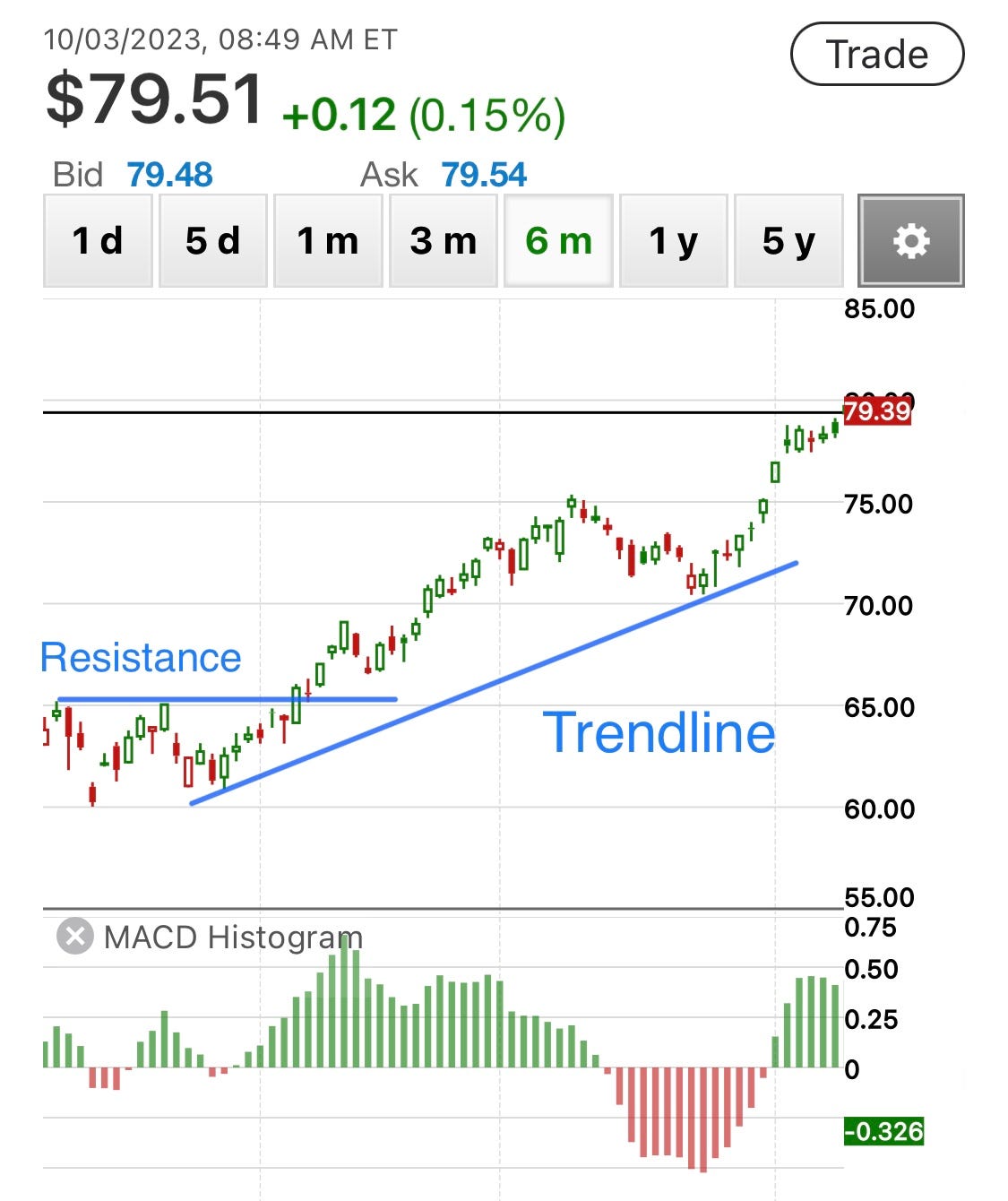
What if the trend has persisted and is virtually over? A trader raises a valid concern, that if a trend is due for a pullback, what might be evidence or a signal for such a pullback or impending reversal? And the question supposes there is predictive evidence.
Caveat:
So, I would add to John’s Rule No. 1 a caveat or corollary :
Go WITH the trend until you see divergence. Divergence would be predictive evidence of the cessation of a trend. This will be discussed in detail later. Any or all of the following principles would be supportive of the trend rule.
- The trend is your friend
- Psychology & Masses
- The Market moves in waves
- Elliott Wave Theory
- Prior highs and resistance
- Fibonacci retrace levels
Any one of these principles might also be a valid reason to exit a trade.
Takeaway — Trading is about timeliness and stacking the odds. The trend is your friend. Trading with the trend puts a trader at an immediate advantage. Trends don’t last forever. A study of basic wave theory will help a trader’s timeliness in both an entry and exit of the trade.
I hope this basic discussion of The Trend Rule 1 gave us food for thought and encouraged the reader to start the process of Trading for a Living. Perhaps open an account and start the side hustle. We will continue the trading rules series with Rule 2.

